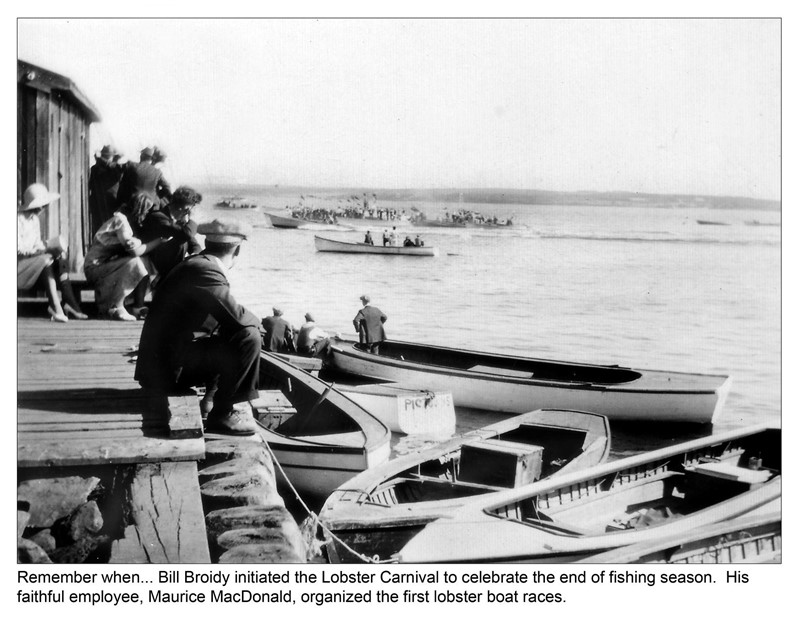
The Pictou Lobster Carnival, held annually, is not only a celebration of all things lobster but also a testament to the rich history of lobster boat racing. As boats skim across the water, vying for victory and the admiration of spectators, the world of lobster boat racing is where the sea meets the spirit of competitiveness. The roots of lobster boat racing in Pictou can be traced back to the mid-20th century when local fishermen, known for their competitive spirit, sought a way to showcase their skills beyond the traditional lobster fishery. What started as impromptu challenges among fishing communities soon evolved into organized events, gaining popularity and turning into a cherished tradition during the Lobster Carnival.
As time passes and the boats advance alongside the new technology that has emerged in the passing decades, one thing has not changed. That is the passion and the dedication that every participant has for the craft. This does pose the question of what makes a champion boat racer? After all these years many have competed at the highest level of boat racing, but what gave them the edge over their competition?
It must be said that competitiveness is one of the keys to becoming a champion racer. The competition was born out of this desire to be the best, that longing for victory is what sets the winners apart from the rest of the pack. Many boat racing champions have shown dedication and a hunger for victory. Within the collection here at the Northumberland Fisheries Museum, we have a book featuring many of the greatest boat racers the Lobster Carnival has ever seen. It is in their biographies that we can see some of the aspects that set them apart from the competition.
One trait found among the best boat racers is expertise in boat handling and maneuvering. One man who was able to deliver on this skill was Leonard Joseph Turple of Pictou. He is one of the racers featured in our collection. He found success with his boats “Molly-Mae’ and “Action Pak.” He recalls fondly a 13-boat race that saw him win by a staggering 58 seconds ahead of the boat that came in second. Leonard was a master when steering, and this led him to become a multiple-time champion.
The speed of the boat is of course another factor in the races. Pair an astoundingly fast boat with an experienced fisherman and you’ve got a recipe for success. The cooperation between man and machine is something that is pivotal to a champion boat racer. Fraser “Fuzz” Shaw could attest to this as he was a multiple-time race winner alongside his boat “Fuzzbuster.” He would take the top prize at the 1996 Carnival where he would wow the crowd in attendance with the speed the boat was able to reach. A true promoter of the race, his enthusiasm always shined through. He was not only a keen competitor but very popular among the spectators. As Fuzz would say “It’s not about the trophy, but the excitement and participation of fellow racers that keeps him coming back year after year.”
Many stories similar to these can be found in the records and displays at NFM.
Of course, no racer can win without their boat. One of the greatest boats in the storied history of the Carnival, the “Silver Bullet,” is among our extensive collection. Built in 1934 by master shipbuilder Sam MacMaster, the well-named “Silver Bullet” was built for Lawrence Johnson of Big Island and went on to win three consecutive years, quite the feat for the time. MacMaster lived with the Johnsons all winter in order to craft the28-foot boat, and took great pride in it, hand-selecting the wood and even crafting the brass nails himself. The success of “Silver Bullet” caused envy among opponents. In one race two opponents tried to cut off the boat, however, the speed was too much for them as “Silver Bullet '' cruised through the gap and caused the two boats trying to cut her off to crash into each other!
In the early races, there were often small prizes handed out alongside the trophy. Some of them included a boat battery, three free haircuts, a bag of flour, and a stove. The trophies won by these racers were quite extravagant, however. What truly kept bringing people to the races was not prizes or trophies, but the love of racing, the camaraderie between the racers, and the spirit of competition. The winners of the boat races were all masters of the event, they are enshrined within the NFM collection, as well as in the community spirit of Pictou. To learn more about champion boat races and the Pictou Lobster Carnival, come pay us a visit here at NFM.